
Why Your Design Reviews Take Weeks (And How to Do Them in Hours)
The design is done. Engineering signed off Tuesday. But it's now Friday, and you're still waiting for the supplier's feedback, the PM's approval, and manufacturing's DFM check.
Design review bottlenecks are a common pain point in hardware development. In many teams, approval delays—not design work itself—account for a large share of calendar slippage.
The Anatomy of a Slow Design Review
Here's the typical flow for a "quick" design review:
- Monday: Engineer exports renders, attaches to email, sends to 5 stakeholders
- Tuesday: One person replies "looks good." Four others haven't opened it.
- Wednesday: Engineer follows up. Two more reply with vague feedback: "something feels off on the left side."
- Thursday: Engineer asks "which left side?" Radio silence.
- Friday: Meeting scheduled for next week to "discuss in person."
What should take hours becomes a 2-week cycle. This pattern repeats across every approval stage.
Why the Bottleneck Exists
| Problem | Why It Happens | Time Cost |
|---|---|---|
| Emails get buried | Stakeholders prioritize urgent fires over review requests | 1-3 days |
| Feedback is ambiguous | Text can't describe 3D problems precisely | 1-2 days clarifying |
| Revisions require re-export | Each change means new renders, new emails | Hours per iteration |
| Meetings required | Complex issues escalate to calls (calendar availability) | 3-7 days lag |
| No single source of truth | Comments scattered across emails, Slack, docs | Hours searching |
The Math: How Delays Compound
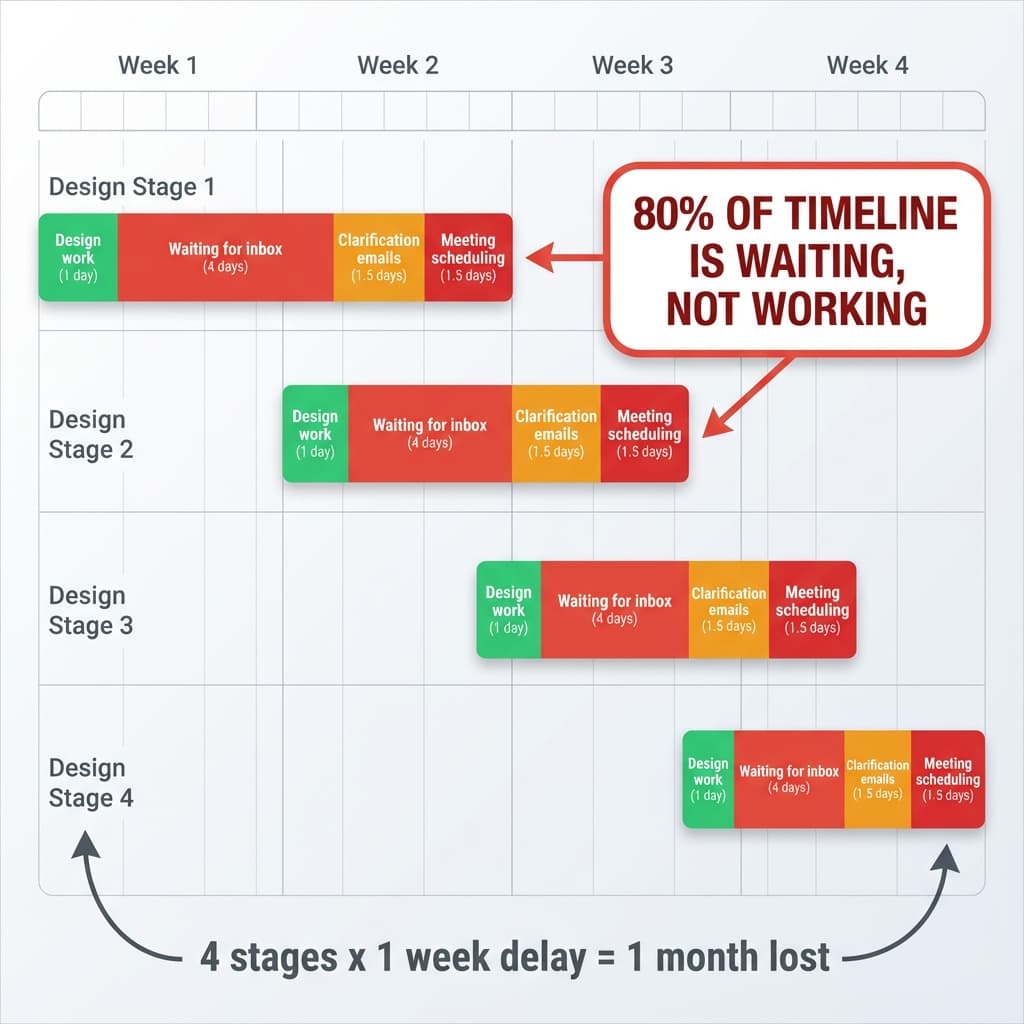
Consider a product with 4 review stages (concept → detailed design → DFM → final):
If each stage has 1 week of approval delay:
4 stages × 1 week = 1 full month of waiting
This is pure delay—no design work happening. Just waiting for inboxes to be checked.
The Modern Approach: Click, Don't Describe
The solution isn't "send more emails" or "schedule more meetings." It's changing the feedback mechanism entirely.
Spatial Commenting
Instead of writing "the clearance on the left side looks tight," the reviewer:
- Opens a shared 3D link in their browser
- Rotates to the exact view with the issue
- Clicks on the specific feature
- Types: "Increase clearance here"
The engineer receives a notification with the exact camera position and annotation. Zero ambiguity.
Async by Default
Everyone reviews on their own schedule:
- Munich engineer uploads at end of their day
- San Francisco PM reviews in their morning
- Shanghai supplier adds DFM notes overnight
- Everyone sees everyone's comments in one place
Resolution Tracking
Each comment has a status: Open → In Progress → Resolved. Stakeholders can see progress without asking "did you get my feedback?"
Before/After: Real Workflow Comparison
| Step | Email Workflow | Spatial Comments |
|---|---|---|
| Share design | Export, attach, compose email | Copy link, paste |
| Give feedback | Write paragraphs describing location | Click + type 5 words |
| Clarify feedback | Reply-all chain, schedule call | Reply in thread at same view |
| Track resolution | Spreadsheet or memory | Built-in status per comment |
| Audit trail | Search email archives | Full history in one place |
Where This Applies
- Internal design review: Engineering lead approving junior work
- Cross-functional review: PM, sales, and engineering aligning on features
- Supplier DFM feedback: Contract manufacturer flagging tooling issues
- Customer co-design: Client pointing to the features they want changed
- Executive approval: CEO giving go/no-go on product direction
Copy/Paste: Async Review Request
Subject: Review requested — [Project] by [Day/Time]

Hi team — please review this design in the link below:
[VIEW-ONLY LINK]

What I need:
- Approve / request changes by: [deadline]
- If requesting changes: click the feature and leave a comment (include what + why)

Context:
- Version: [Rev / date]
- Focus areas: [e.g., enclosure fit, fasteners, clearances]

Thanks!
Key Takeaways
- ✓Approval delays—not design work—often cause project slippage
- ✓Email is linear; 3D problems need spatial feedback
- ✓Click-to-comment eliminates ambiguity
- ✓Async review works across time zones without scheduling
FAQ
Don't we still need meetings for complex discussions?
Sometimes. But async feedback handles 80% of issues. Meetings become rare escalation, not default workflow.
How do we get suppliers to adopt a new tool?
They click a link and comment in their browser. No downloads, no training. If they can use Google Docs, they can use this.
What about regulated industries that need documented approval?
Spatial comments with timestamps provide better audit trails than email chains. Export the full comment log for compliance records.
Stop waiting for inboxes. Start clicking.
Reific replaces meetings and reply-all with spatial comments on a shared 3D link—faster approvals, fewer clarifications.
Speed Up Your Reviews